Showing posts with label Tzaddikim. Show all posts

Sunday, 15 January 2012

Rabbi Yaakov Abuchatzeira - The Abir Yaakov - Yahrtzeit 20 Tevet

Baba Sali - The Abir Yaakov - Baba Meir

Rabbi Yaakov Abuchatzeira (1806 – 20 Tevet 1880) was the direct descendant of that great Tzaddik – Rabbi Shmuel Elbaz (a pupil of Rabbi Chaim Vital, the student of the great kabbalist, the holy Ari) who was given his surname Abuchatzeira (father of the mat) because of a famous story told about him. 

Rabbi Shmuel was a great Torah scholar and great man who was chosen by his friends to collect charity funds for the Yeshiva by travelling overseas in search of wealthy donors. On approaching the captain of the ship and asking for the opportunity to board the ship (without the necessary funds,) he was denied. He offered to take the basest of places on the ship and work for his upkeep while aboard. The captain however, denied him yet again. With no other choice, he removed a mat from his bag, threw it upon the waters and "rode" the mat! When the captain saw that he was a holy man, he offered him a free ride. An offer that was no longer accepted! 

From that day onwards, Rabbi Shmuel was known as Rabbi Shmuel Abuchatzeira or "Father of the Mat" in Arabic. Indeed, all his descendants after him followed in his path – holy men blessed with Divine Inspiration, great men filled with kindness. Just a few generations later, his descendant Rabbi Massud – the great Rabbi of Tafilalet would have an amazing story to tell…

A couple came to the Rabbi seeking a divorce. The Rabbi granted the divorce, but the woman had wanted to stay a little longer in order to talk to the Rabbanit. Night fell, and fearing for her life – the Rabbanit suggested she stay with them for the entire night. That evening, Rabbi Massud had a dream… He was told that the woman staying over was destined to give birth to a very great soul. However, it was to emanate from a holy union – one between the Rabbi and her. He was instructed to marry her three months later. Rabbi Massud had no idea how he would tell his wife about this mysterious dream!

It turned out however that the Rabbanit had the exact same dream – and was told of the importance of her husband marrying this woman. The Rabbanit (a holy woman herself) accepted this decree and convinced the woman to marry her husband.

Upon returning from shul that morning, before Rabbi Massud had time to tell over his own dream, the Rabbanit approached her husband informing him that the woman had already accepted! A short time later, a son was born to the couple – Rabbi Yaakov! He would become the great man – the Abir Yaakov, an outstanding Tzaddik, whose grandson the world today know well – the Baba Sali – Rabbi Yisrael Abuchatzeira!

Rabbi Yaakov's piety was outstanding. His Torah learning was on a level far beyond what even the greatest of our generation can fathom. He wrote twelve masterpiece books. These books are a must for anyone pursing the study of the mystical kabbalistic tradition – and also for those wishing to understand Halacha – the revealed part of Torah, appropriately.

Rabbi Yaakov's days were filled with Torah learning from day to night. He slept very little. He had a specific way of teaching Gemara. He would cover the commentaries of Rashi and Tosefot and learn only the words of the Amoraim – trying to understand the Gemara on it's own – without additional assistance. Only afterwards when his students had given their learning the best chance by themselves, would he go ahead and look at the commentaries. He would say, "First roshi, then Rashi" – "First my head, then the commentary Rashi". In the afternoon Seder he would teach Reishit Chochma, Peleh Yoetz and Shevet Mussar. 

Each evening he would learn 18 chapters of Mishna – covering the entire Oral Law (Shas) each month! This he would do completely off by heart! Shortly before midnight, he would sleep, only to awaken to begin the prayer of Tikkun Chatzot – mourning for the Temple. He would then learn the Eitz Chaim, Mevo Shearim and Zohar. He would proceed to be one of the first ten in shul, and after davening, continue to learn. He would eat very little and spend much of the day involved in distributing charity to those in need. It was all of this that made him into the outstanding Tzaddik and true Mekubal (kabbalist) that he was.

Rabbi Yaakov performed many wonders and miracles for the Jews of Morocco. Childless couples were blessed with children, many sick were healed and many who were depressed left his presence filled with new life and happiness!

In the city of Paranda, there once lived a very depressed, bitter and disheartened woman who had a son of 16 years of age. He had been stricken with polio and was paralysed in both legs leaving him in a wheelchair for life. So depressed was the woman, that she prayed that the child should die!

One day, Rabbi Yaakov was visiting Paranda. When the ruler witnessed the commotion taking place with the Jews singing and dancing at the happy occasion of seeing the Rabbi, he wondered about it all. He ran to find out what the commotion was all about, and upon being told about the great Rabbi that had been accorded such honour he became intensely jealous! He decided to levy a heavy tax upon all the Jews for their "rebellious" behaviour!

Later – after a short rest, Rabbi Yaakov began to accept the public for blessings and offer advice. Among the people who came was this very woman. She entered and told Rabbi Yaakov's host that she wished for the Rabbi to pray that her son should die! He asked her to explain herself, and related the story to Rabbi Yaakov.

Rabbi Yaakov listened to the request and told the host that he would not pray for the son to die, but rather to be completely healed. He explained to the host that he should tell the woman to bathe her son, dress him in clean garments and bring him to see him.

The next day, the woman arrived with her son – having "prepared" him as the Rabbi had requested. The Rabbi instructed that the son should be brought through on his wheelchair to a place in the room directly underneath a skylight where the sun would shine upon him. Rabbi Yaakov asked the boy his name, and then instructed him to get out of his wheelchair and come over to him. He instructed him to return to his wheelchair and then to get out and approach him again – and then yet another time. Thereafter, he told the boy that he could return with his mother and that he would merit health and longevity.

The community was abuzz with excitement at the good news, for everyone had known of the revealed miracle that had taken place. The mother brought the story to the attention of the ruler of the city. She had sold jewellery to the people of the town and had been in touch with the ruler before. This time, however, she would be introducing a new person to her team and would have to introduce the young boy to the ruler. She would also have to explain why she had never introduced the boy before.

The ruler, who had known how sad this woman had always been, and now seeing her glowing face realised the great miracle that had taken place through the distinguished guest! He regretted his previous decision to tax the Jews, and after nullifying his decree, welcomed the rabbi into his home. He invited many guests to his home that day and told them the story of the miracle rabbi who had healed a young boy who had never been able to be cured through the best of the doctors of the town! Now, with just a few words, the rabbi had cured the boy completely!

Rabbi Yaakov arose at the meal and in humility told the guests how it was not he who had healed, but rather G-d, the Creator of the world, who had done the wonder! He explained that it was only because he himself fulfilled the words of G-d that G-d had allowed him to be the vessel through which the miracle would occur. Hashem answers the prayers of those who study His Torah and fulfil His Mitzvot – he explained.

Rabbi Yaakov performed a wonderful Kiddush Hashem!

There are many wonderful stories about this exceptional Tzaddik and of course his descendants who followed afterwards.

May the merit of this Tzaddik, and the Rambam (whose Yahrtzeit also falls on this same day!) protect us all and bring blessing to each of us where we need it most in our lives.

*Baba Meir - **Baba Hana - Baba Sali - Abir Yaakov - ***Baba Chaki 

* Baba Meir - Rabbi Meir Abuchatzeira, eldest son of Baba Sali

** Baba Hana - Rabbi Avraham Abuchatzeira, son of Baba Chaki and direct grandson of Baba Du (Rabbi Dovid, Baba Sali's older brother who died Al Kiddush Hashem)

*** Baba Chaki - Rabbi Yitzchak Abuchatzeira, Baba Sali's younger brother

Sunday, 10 July 2011

9 Tammuz - Yahrtzeit of the Klausenberg Rebbe


The 9th Tammuz marks the Yahrtzeit of the Tzaddik - the Klausenberger Rebbe - Rabbi Yekusiel Yehuda Halberstam. He survived the Holocaust - though came out having lost his entire family including his wife and 11 children. Should he survive - he said to himself, he promised he would build an entire hospital devoted to saving the lives of people. The Laniado hospital in Netanaya is the hospital that he built - a most remarkable hospital. Those members on its staff must comply with the most basic of all regulations, to treat people with respect and dignity.

Well known is the famous story when money was lacking to build the hospital. He was asked his opinion about which syringe needles to purchase. He asked what the problem was. They told him that one type of needle is much cheaper, but it stings the patient when inserted. The other costs far more, but it hurts less. It wasn't a question for the Rebbe. The latter was to be used at all costs!

There are some beautiful biographies written about the Rebbe. An exceptional person by anyone's standards. Having been through a world of hate - he was filled with nothing less than pure love. Who can even begin to compare to the greatness of such rare individuals?! But it is for us to strive to these levels. To stop the constant hatred and desire for war and death, and instead to focus our lives - every minute and every second of them to building places that help, that bring peace, that bring life. When will we stop with the stupidity of war, the baseless hatred of others and our desires to speak big about peace without being prepared to do anything to back it up?!

Life is real. It's not just about the latest I-gadget, and it's certainly not only about the "I" gadget. We need to read the heart breaking story of this Tzaddik - and then read it again. And then when we're finished it, we need to read it... again... because it seems, we still have a long way to go until we appreciate what life is really all about.

Below are two videos about the Tzaddik. The first is he himself speaking as he describes briefly - the multitude of tragedies he went through in his life. But it's enough for most of us to hear - because we still find it hard to believe that there are so many out there who still do not believe it, who do not even believe that there are many still wishing to continue this destructive behaviour in the lives of others.

The second video is all about the wonderful hospital he built. He never had any money to do it of course. He was by no means wealthy. But he chose to look the other way from those who might think to dissuade another for raising funds to build a building of life. He asked for those funds - and to those who gave, they will be blessed - forever.


Zechuto Yagen Aleinu - May his merit protect us.
May the soul of Rabbi Yekutiel Yehuda ben Tzvi זצ"ל merit to ascend level upon level -
and may it merit to stand before the Throne of Glory to plead our case in full,
to turn all the judgments of the world into mercy and hasten the final redemption - immediately!


Monday, 27 June 2011

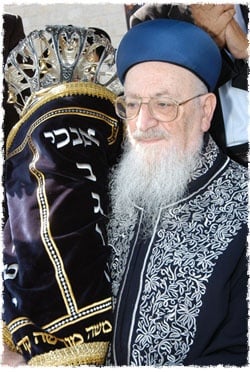
First Yahrtzeit of Rabbi Mordechai Tzemach ben Salman Eliyahu

Today - the 25th Sivan 5771 marks the first Yahrtzeit of the former Chief Rabbi of Israel - Rabbi Mordechai Eliyahu. The story below (a well known story about Rabbi Eliyahu) is taken from www.ascentofsafed.com. See below post for more info.

Only One Did Not Faint

One of Rabbi Mordechai Eliyahu’s early predecessors as Rishon L’Zion, Sephardic Chief Rabbi of Israel, was Rabbi Yitzchak Nissim, who had a special appreciation and admiration for the CHIDA (Rabbi Chaim-Yosef-David Azulai – see below). One of Rabbi Nissim’s friends was Dr. Shlomo Umberto Nachon, a native of Livorno (Leghorn), where the Chida lived the end of his life and was buried.

In the late 1950’s, Dr. Nachon learned that the Italian authorities wished to build a highway through the Jewish cemetery of Livorno. He quickly informed Chief Rabbi Nissim and, understanding the urgency of the situation, they decided it was time to move the Chida to Eretz Yisrael. Dr. Nachon made the arrangements with the authorities in Livorno, and in 1960 Rav Nissim, after much coaxing, commissioned the then 31-year-old Rabbi Mordechai Eliyahu, who was known to be intimately familiar with the Chida’s writings, to head a team of esteemed Sephardic rabbis (which included Rabbi Yisrael Abuhatzeira, the Baba Sali, and his brother the Baba Haki, Rabbi Yitzchak Abuhatzeira, chief rabbi in the city of Ramle, who was an expert in Jewish burials in his native Morocco) for the reinterring of the bones of the Chida in Jerusalem.
MordechaiEliyahu.jpg
Rabbi Eliyahu related that when he arrived at Lod Airport with the other rabbis, he met with the agency representative who had brought the bones of the Chidain a small wooden coffin. When the Rav saw it, he was appalled “What is this?” he asked. “The bones of the Chida are rolling around in a miniature coffin? How can such a thing be?”

He asked that a larger coffin be brought, so that the bones could be transferred to it for an honorable burial. Then he requested that the Baba Haki's driver go with his driver, and that they immerse in a mikva [ritual bath], and afterwards buy a Phillips screwdriver to open the coffin.
When they returned, Rabbi Mordechai Eliyahu made a large hole in the bottom of the new large coffin so that there would be no barrier between the bones and the soil upon burial, but temporarily closed the hole with a stopper. Then he opened the small coffin, and put his hand in to arrange the bones. But after a few moments he trembled and closed his eyes, and said he had no power to do it and asked pleadingly from the Chida that he himself should put his own bones in order.
Immediately a powerful, almost explosive sound was heard, the coffin began to shake, and a rattling sound -- made by the Chida 's remains striking the coffin's walls -- was heard. All of the other rabbis fainted on the spot. Rav Mordechai did not faint, explaining afterwards that this occurred because he was absorbed in themitzva.
It was incredible! The bones managed to re-arrange themselves bone by bone, until the entire body was in order -- real resurrection! --  in the merit of the holy master, the Chida!
“G-d will grant you special Providence, and bring my remains out of this place.” [Gen. 50:25]
“He said to me, ‘Can these bones live?’…As I prophesied, there was a roaring sound, and the bones came together and joined one another…. ‘I am going to open your graves; I will take you out of your graves, My People, and bring you to the Land of Israel.’” [Ezek. 37:3, 7, 12]
Thousands accompanied the funeral procession from the Jerusalem neighborhood of Sanhedria to the cemetery at Har HaMenuchos. At the burial, Rav Eliyahu described the events that had taken place as “Nisei nissim--absolute miracles.”
At a later date Rabbi Mordechai Eliyahu announced that whoever needs personal salvation can go to pray at the grave of the Chida (just like at other great holy sites –ed.).
It is no wonder that when Rabbi Mordechai Eliyahu passed on to his heavenly great reward fifty years later that he was buried near the Chida on Har HaMenuchos!
~~~~~~~~~~~~~~~~
Source: Adapted from //heichalhanegina.blogspot.com/2010/06/rav-mordechai-eliyahu-ztvkl-and-chida.html . There Yitz explains that his main source is the version of RME himself, with supplementary details supplied from other versions. He also considerately supplies links to other sources.
Connection: First yahrzeit of Rabbi Mordechai Eliyahu on 25 Sivan (Monday June 27).
Biographical notes: Rabbi Mordechai-  Tzemach (ben Suliman)   Eliyahu (1929- 25 Sivan 2010) , the former Chief Sephardic Rabbi of Israel, was born in Iraq. A noted sage in all areas of Torah study, as well as a significant kabbalist, he was considered to be one of the leading authorities on Jewish law in Israel. His son, Rabbi Shmuel Eliyahu, is currently the Chief Sephardic Rabbi of Tsfat.
s708chida.jpg
Rabbi Chaim-Yosef-David Azulai (circa 5484-5566; 1724-1806), better known as the "CHIDA," which are the initials of his name, is a highly respected Halachist, Kabbalist, historian and bibliographer. Born in Jerusalem, his teachers included Rav Shalom Sharabi [the Rashash], and Rav Chaim ben-Atar (the Ohr HaChaim). Eventually he wrote and published 71 works! His Shem HaGedolim" is one of the most important source books of Jewish literature and history. Several times he traveled abroad for periods of over five years each, usually as an emissary of the communities of the Holy Land, and once to serve as the Rav of Cairo. He lived the last third of his life in Livorno (Leghorn), Italy, where he wrote most of his major works and where he passed away at age 82 and was buried.

Saturday, 26 March 2011

The Great Value of a Beautiful Wife: Dedicated to Those Special Women...

We read stories about the Tzaddkim at the Melave Malka (the fourth "Shabbat" meal) as we see the Shabbat out - to bring blessing into our next week - to take a message with us and hold on to it as we work through another six days - until another special day of rest.

This story from Ascent of Safed is dedicated to all those beautiful women who value their husbands, support them in doing more goodness and kindness in the world, and who value the Torah as the ultimate guide in helping us all reach these beautiful goals. May those on the receiving side be worthy of giving back to them appropriately to thank them in some way for their truly altruistic kindness.

Dedication
In loving memory of ARYEH-LEIB HAKOHEN ben Eliyahu & Malka (Leon A.) LAUTERBACH, 
who just passed on to his heavenly reward on Shabbat Erev Purim.
 
The Feminine Antidote

The Midrash says that Aharon's two oldest sons, Nadav and Avihu, died young at the time of the dedication of the Tabernacle in the desert because they never married. However, the Torah verse (Lev. 10:1,2) specifically says that they died for having brought alien fire to the holy altar. How are we to reconcile these conflicting reasons?

Consider the possible answer provided by the following story.

Rabbi  David of Zubeltov, son of the rebbe, Rabbi Menachem Mendel of Kosov, once became so ill that even the best physicians despaired of his life.

Not so his wife, Rebbetzin Pesya Leah, daughter of the eminent Sassover Rebbe. She refused to make peace with this decree. She sat by her husband's bedside and did not cease her praying and weeping. "Please, G-d," she pleaded tearfully; "let my saintly husband recover."

The good woman's fervent prayer split the very heavens and, despite the doctors' gloomy prognosis, the patient began to improve slowly. Soon her husband was back on his feet, leading his flock as before.

Reb David'l knew to whom he owed his recovery. He was well aware of his wife's devoted prayers. Once, in the company of his closest chasidim, he said, "Now that I am healthy again, I understand why the Midrash says Nadan and Avihu died because they did not have wives. If they had had wives like my own worthy Rebbetzin Leah, who would have prayed for them, they would surely have been saved from death despite their having brought improper fire before G-d!"

~~~~~~~~~~~~~~~~
[Source: Adapted by Yerachmiel Tilles from "Tales of Tzaddikim" (ArtScroll) by G. MaTov]

Connection: Weekly Reading – 10:1-2

Biographical note: 

Rabbi  David of Zubeltov (1797 - 25 Iyar 1846) was the son of Rebbe Menachem Mendel of Kosov and the son-in-law of Rabbi Moshe Leib of Sassov. He became a rebbe in his own right at the young age of 29. He was held in great respect for his wisdom, even by the other rebbes of his generation.

Friday, 25 September 2009

One of the 36 Hidden Tzaddikim - Rabbi Aryeh Levine


ONE OF THE 36 HIDDEN TZADDIKIM

There is a well known concept that in every generation there are 36 hidden Tzaddikim – righteous individuals. According to the Tanya – the magnum opus of the Alter Rebbe, the first Rebbe of Chabad, a Tzaddik is someone who has no evil inclination. His every thought, speech and action is devoted to pure goodness. Practically speaking – he cannot think bad even if he would (theoretically) want to. It is a level which is really given to a person at birth.

Rabbi Nachman of Breslov – on the other hand – teaches that everybody can become a Tzaddik. In fact, he would become very angry at those that would attribute his level of righteousness to the fact that he was the grandson of the holy Baal Shem Tov. He would tell them that he worked on himself until he acquired his great levels of righteousness.

Which one is it really?! Are Tzaddikim born, or can one become a Tzaddik by working on oneself through learning much Torah and engaging in many good deeds?

This of course refers to the "regular" Tzaddik. In addition to the "regular" Tzaddik, is a group of select individuals all on their own. They stand out from the crowd in that one can often never really identify them properly. Their essence is devoted to complete goodness, yet the world doesn't seem to know about these people or hold them in much high esteem, if any esteem at all.

It is also taught that the hidden Tzaddik must be hidden so that others not know the work he is doing to rectify the world. If anybody would find out his status, he would be required to leave this world – immediately. Such is the greatness of the hidden Tzaddik. He is here with us, yet most of us are simply too naïve and foolish to actually be able to identify him, honour him and respect him for his greatness. Of course, he neither needs our honour or respect. He knows well himself of his own achievements and contributions to the world. With regular visitations from the prophet Eliyahu (Elijah the Prophet) and other Tzaddikim and great souls and angels that appear regularly to him, he is well aware of his mission in the world.

We are taught, that in fact, there are 36 of these hidden Tzaddikim that maintain the world at any one time. No more… no less. They are scattered about, doing their jobs faithfully – while we may often even encounter them, insult them, and take no notice of them even when we are in their very presence!

As we approach Yom Kippur, we should surely consider the ideas of Rosh HaShanah and the three books open in front of G-d at that point in time. One for the Tzaddikim (to be inscribed for life), one for the Reshaim (to be inscribed for….) and one for the middle-man – the Beinoni. He is given ten days to improve himself so that he too will be inscribed in the book of life and be considered a Tzaddik.

One wonders though – if one could get a glimpse of a real hidden Tzaddik, what would he be like?! If they are around, then isn't it fair that we learn from them at some point in time? After all, if life is about doing good and kind things – and the hidden Tzaddikim seem to be able to do this all the time – wouldn't it be best for us to know at least one of them, so that we too could learn the right way to behave?

Indeed, every now and again – G-d gives us a glimpse into the life of one of them. Such was the life of the Tzaddik Rabbi Aryeh Levin. He may well have "left" the world some 40 years ago – but his life is certainly one that we can all learn from today.

A video documentary was made about his life - but it is no longer available online. If you are able to view it, you will see a beautiful introduction into a peek of the life of this Tzaddik – someone who we can all learn from. We can learn what life is really all about. Rabbi Benjy Levin is Rav Aryeh's grandson and it could well be that if you are in touch with him, he may be able to assist in your obtaining this beautiful documentary.

At the end of the video, someone who was affected by Rav Aryeh shares a beautiful teaching from him. He once asked Rav Aryeh if indeed he was one of the 36 hidden Tzaddikim. Rav Aryeh answered him that the hidden Tzaddikim are not a select group of people born into this world to fulfil a full life of righteousness from beginning to end. Rather there are always 36 hidden Tzaddikim in the world involved in Mitzvot and kind deeds. However, some of these individuals will be involved in this amazing goodness for just a moment, others a minute, others an hour or a day… maybe more. While engaged in their goodness, it is they who are the hidden Tzaddikim at that point in time – the reason for G-d's having created the world. When they finish their service, they leave the status of hidden Tzaddik, and let another take it over. At any one time, there will always be these 36 people involved in the most amazing goodness and kindness in the world. But the flame is transferred from one to another. At some point in time, that flame may even be in your hand. It will then be you – who is the hidden Tzaddik. Of course, you can choose how long to hold on to that title for, to continue with that goodness and be one of the 36 hidden great and righteous individuals who maintain this world – who G-d created the world for. The choice is all of ours.

Though we may not be the Tzaddik that the Alter Rebbe speaks about – or even that one that Rabbi Nachman of Breslov speaks about – each of us has the opportunity – every single moment to be the hidden Tzaddik that Rav Aryeh Levin speaks about.

Should you wish to learn more about this Tzaddik, why not purchase the book about his life? "A Tzaddik in our Time" by Simcha Raz can be obtained via Amazon by simply clicking on the link below!


Wednesday, 28 January 2009

Yahrtzeit - 4 Shevat - Rabbi Yisrael Abuchatzeira - Baba Sali


YAHRTZEIT
BABA SALI
TZADDIK AND AUTHENTIC KABBALIST
RABBI YISRAEL ABUCHATZEIRA

4 SHEVAT

Born: 1890 (Rosh HaShanah)
Died: 1984


Rabbi Yisrael Abuchatzeira is one of the most famous miracle rabbis known today. He was born in Morocco and made Aliyah much later in his life. 

He was known as an Admor (meaning the equivalent of a Chassidic Rebbe) and had the additional abbreviation Meluban added after his name – meaning “accustomed to miracles”. He was a true servant of G-d in every sense of the word, wanting nothing else in his life than to fulfil G-d’s wishes. Although an Admor in his own right, he had a strong connection with many of the other Chassidic Rebbe’s including the Lubavitcher Rebbe. There is a famous correspondence between the two. The Baba Sali wanted very much to learn and live by the Lubavitcher Rebbe i.e. in New York with him. The Rebbe wrote back telling him that G-d had blessed him with powers that were meant to help those in Israel where he ended up living. It was because of this that the Baba Sali ended up settling where he did!

He was an authentic Kabbalist – not like the popular “Kabbalist” of today’s generation. He did not use his “magical powers” to perform things to show off. On the contrary, it was because he was so attached to G-d at all times, that “The Tzaddik decrees and G-d fulfils.” He never made use of his knowledge of practical Kabbalah. His powers and Ruach HaKodesh came not from practical use of G-d’s Names and the like, but rather because of his extreme holiness!

His father was the first born son of Rebbi Yaakov Abuchatzeira – well known for his knowledge of Kabbalah and his complete devotion to Hashem. He in turn was a direct descendant of Rebbi Shmuel Elbaz – a pupil of Rabbi Chaim Vital, the student of the holy Arizal!

The most famous story concerns how “Elbaz” became known as Abuchatzeira. In those days, it is told, one person from the Yeshiva would go around collecting the necessary funding to help the Yeshiva (and those learning in it) to be supported monetarily. There were no cars in those days, and in fact, in order to build up wealth, it was necessary to travel overseas – and that was done *without* an airplane! The only means to do so was by ship.

In the Yeshiva where Rabbi Shmuel Elbaz (a great Tzaddik himself!) learned, they decided to cast lots by drawing thin sticks from the hand of one person. Various sizes were placed in the hand, making them all look the same size. The person picking out the shortest stick would be chosen for the arduous journey across the sea. As things turned out, this time it was Rabbi Shmuel who chose that “unwanted” stick, and he set out immediately onto his Shlichus (mission) to bring in the funding necessary to simply continue living and be able to continue learning.

Rabbi Shmuel was a humble man. He set out to the dock, and saw a ship ready to set sail. The fee to board it was a high one, and Rabbi Shmuel lacked the money to purchase a ticket. What would he do?! He approached the captain and asked him if he could perhaps board it, and take up some lodging aboard the ship where the storage rooms were. A place perhaps – where brooms were stored – and there would be just enough room for him to stay closeted in. The captain refused. 

Rabbi Shmuel told the captain that he would be delighted to work for his boarding of course! He would clean the deck, serve the passengers food, whatever it would take. The captain refused.

There was nothing Rabbi Shmuel could say or do to convince the captain to take him aboard. Rabbi Shmuel knew well the importance of his mission and realised that he would still travel – no matter what! The ship set sail shortly thereafter. As it did so, Rabbi Shmuel took out a mat that he had brought with him to sit upon. He threw it open upon the waters. The mat floated. Rabbi Shmuel sat on top of it… and it continued to float, moving at the same pace as the large ship. Suddenly people were shouting about at the miracle they were seeing in front of their eyes. The commotion alerted the captain, who realised that his “poor Jewish peddler beggar” was in reality a very great man – a Tzaddik. Naturally he offered him a wonderful cabin onboard with all sorts of delights to honour the great Tzaddik!

Rabbi Shmuel declined, and continued the entire journey next to the ship until he reached his destination! From the day this story became known, Rabbi Shmuel became known as Abu Chatzeira – or the translation of these Arabic words, “Father of the Mat.” Since then, all of his descendants have been known as Abuchatzeira.

Of course, his descendants did not only inherit this prestigious name, but also the ability to perform miracles – naturally!

To tell the stories about Rabbi Yisrael Abuchatzeira, would fill volumes of books, and indeed many have been printed. Each better than the next, filled with stories most of us would think of only as fantasy and fairy tales. Ironically – they’re true!

Being a holy man, Rabbi Yisrael guarded his eyes from any site forbidden by the Torah. He would wear a cloak around him that completely shielded him from anything “unsightly”. In addition, he would usually walk, accompanied by his Gabbai (sexton) wherever he went – even when it was to the Mikvah! In this way, he could keep his eyes on the ground without bumping into anything.


A story is told of the young Rabbi Yisroel. He came home from school one day and approached his father R’ Massoud. He told his father that he had been in class, and one of his classmates had done something terrible (R' Yisroel never stood for injustice!), and so he had considered cursing him for it! R’ Massoud scolded R’ Yisrael and told him that his mouth would be used for giving blessings when he would get older – blessings that would be fulfilled, and that he should never use it for bad things. Needless to say, R’ Yisrael never spoke any bad word again. Indeed his mouth was used for blessings, and the very words themselves would cause miracles to happen.

He was also known for his miracle of making Arak (a very strong alcoholic beverage) appear from nowhere. He would have a celebration at his home, inviting many guests – who he promised would never get drunk from drinking Arak while with him. Nobody ever did! When the Arak would reach the bottom of the bottle, R’ Yisrael would place a cloth over the bottle, and then continue to pour as if pouring from a full bottle. The Arak never ended.

R’ Yisrael wasn’t known for his celebrating though. On the contrary, he spent much time fasting. So much so that one can see from the thinness of his body – just how much he must have fasted! Often, R’ Yisrael would undertake a very dangerous fast – known in Kabbalah as a Taanis Hafsaka – an interrupted fast! It is called “interrupted” because the fast begins after Shabbat, and continues until the beginning of the next Shabbat (which interrupts it!) There is no eating or drinking during this entire time. So great is this fast, that the Kabbalah speaks of it as being the equivalent of thousands of ordinary fasts!!! (NOTE: This should NOT be undertaken by ANYONE! Fasting in general is something that needs to be discussed with one’s Rabbi before doing anything like this. There are far greater ways of doing Teshuva today than to weaken the body and find oneself unable to do anything as a result, or worse, become severely sick!) In addition, R’ Yisrael would recite the Tikkun Chatzot prayer (midnight prayer for the destruction of the Temple) every single night – after which he would study Torah until the morning and then pray.

R’ Yisrael had already begun this holy path of life even before he was 13 years old! His older brother R’ Dovid HY”D (a very great Tzaddik who was killed Al Kiddush Hashem!) noticed him the first time he undertook this fast, and seeing his weakness (hidden from everyone else apparently!) he scolded his brother telling him that there was no reason for someone so young to have to fast. He wasn’t even BarMitzvah – what could he have done wrong?! The truth is that R’ Yisrael had never done anything wrong. His entire life was devoted completely to G-d.

The stories concerning his level of Kashrut are legendary. He refused to eat any processed food, and only ate from what his wife would cook for him. He had his own private Shochet who he trusted (and tested!) and would eat no other meat! (A far cry from today’s “Kashrut experts” who believe that any food product with any sign that indicates that it is Kosher means it is Kosher, not having a clue about the actual standards used!)

Such a Tzaddik comes into this world but once in many many generations. His Brochas are legendary, and those who read about this great Tzaddik today long to receive a blessing from him.

His eldest son R’ Meir died just months before he did. In fact, R’ Yisrael said that after his son died, there was no reason for him to continue living, and died within the year! R’ Meir had five sons – Rav Elazar (murdered 27 Tammuz 5771 by Asher Dahan) Rav Dovid, Rav Refael, Rav Yeshua Ve'Rachamim and Rav Yekutiel. All the sons are outstanding Mekubalim in their own rights. Rav Dovid has a Yeshiva in Nahariya. The Baba Sali had another son - Baba Baruch - born to him in his old age. 

The Baba Sali is buried in Netivot where he lived for the last years of his life.


If you are interested in purchasing any of the books of the Abir Yaakov (Baba Sali's grandfather,) Rabbi Dovid HY"D (Baba Sali's brother) or biographies about the family, be in touch with Reb Eliyahu. Books are sent from the Holy Land of Israel!

Light a candle for Baba Sali
Yisrael ben Massoud

May the merit of this Tzaddik stand by us all
and help us in being granted
all the salvations that each of us needs.

LinkWithin

Related Posts with Thumbnails